
20.11.2025
MUSICA helps upgrade TU Wien’s research matrix
Austria’s new flagship supercomputer MUSICA has enabled the training of a Large Language Model that analyzes, groups, and labels all research fields at TU Wien.
TU Wien is revising its research matrix using a data-driven approach. As part of the project Research Spheres, the university analyzed its publication and project data to identify thematic structures across all research areas.
With around 4,600 researchers working across 51 institutes and publishing approximately 700 articles each year, TU Wien generates a substantial and diverse body of scientific output. Together with project submissions and individual research profiles, these publications form the basis for a renewed, evidence-based research matrix.
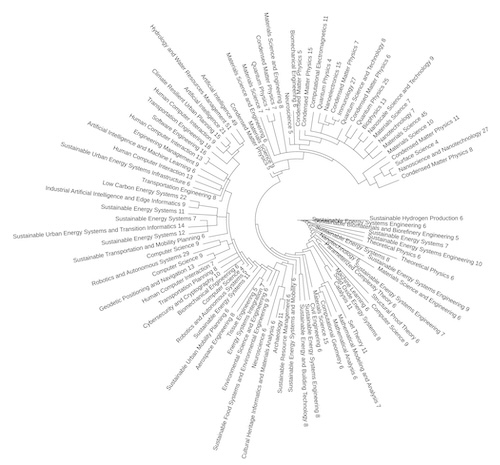
According to project lead Elisabeth Schludermann, the previous matrix – introduced in 2009 – no longer reflects dynamic fields such as AI or high-performance computing. Research Spheres therefore aims to build approaches and tools that represent TU Wien’s research landscape in a way that is data-driven, meaningful and up-to-date.
To support this, around 30,000 publication abstracts and 2,000 project submissions were processed, cleaned and converted into embeddings. Based on these embeddings, thematic clusters were formed and arranged hierarchically to visualise how research topics relate to one another. A Large Language Model (LLM) then assigned descriptive labels to each cluster, providing a structured overview of TU Wien’s research fields.
Early success story for MUSICA
An essential part of this work was performed on Austria’s new national supercomputer, Multi-Site Computer Austria – MUSICA.
With help of the HPC competence centre EuroCC Austria and the ASC team, Thomas Haschka – AI specialist at TU Wien’s dataLAB – got early access to the system during its closed test phase.
Using 80 GPUs from MUSICA’s 272 GPU nodes and 168 CPU nodes, he programmed the clustering algorithm and deployed the associated LLM. The scale of computation required for embedding, clustering and labelling would not have been possible without MUSICA’s capacity. Even with MUSICA, annotating all research fields from all the abstracts required three days of uninterrupted compute time.
This makes the Research Spheres project one of the first large-scale AI workloads successfully executed on MUSICA, demonstrating the system’s suitability for data-intensive research.
MUSICA in the open test phase
Currently, MUSICA is in open test phase and accessible to the members of all partner institutions that use the other ASC clusters, without any cost, for the duration of the test phase. For more information, visit our support page: https://docs.vsc.ac.at/musica_test/.