
05.12.2025
Research highlight: Studying upward lightning with AI and supercomputing
Lightning is usually triggered inside a cloud and strikes downward – but there is a lesser-known opposite phenomenon. At the University of Innsbruck, Isabell Stucke is investigating how it works.
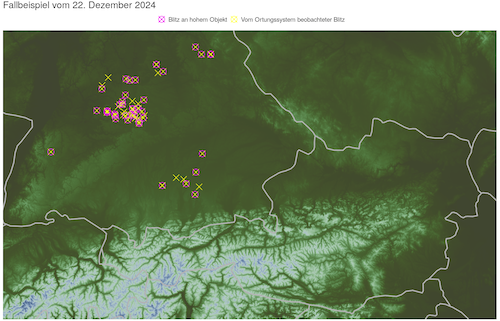
Unlike the lightning we see in summer thunderstorms, upward lightning develops under cool, windy winter conditions with high ice content in the atmosphere. It occurs more frequently north of the Alps, in regions with dense infrastructure such as Germany, where very large wind farms are located. Observations show that human-made structures actively influence lightning activity; when a wind farm is built, lightning frequency can increase significantly, turning certain areas into winter lightning hotspots.
The increase in turbine height is another contributing factor. Twenty years ago, wind turbines were about 100 meters tall. Today many exceed 300 meters. The taller the structure, the higher the likelihood that it won’t be struck by a downward lightning bolt but will instead trigger an upward one.
Today, upward lightning is among the most common causes of damage to wind turbines. Reaching up to 30,000 °C, which is about six times hotter than the surface of the Sun, upward lightning often carries electrical current for longer than a typical lightning. This extended current puts turbine components under severe thermal stress and increases the risk of damage.
A research niche with global relevance
Only a small number of scientists worldwide study upward lightning, and very few from a detailed meteorological perspective. Isabell Stucke, a postdoctoral researcher at the Department of Atmospheric and Cryospheric Sciences (ACINN) at the University of Innsbruck, belongs to this small group. As Stucke notes: “At conferences, people often say: I’ve never heard of that before.” Her work includes comparisons between Austria’s Gaisberg measurement station and wind farms on Japan’s west coast. Despite the very different climates, both regions show remarkably similar atmospheric conditions that favor upward lightning.
Data, scale and why HPC matters
Predicting upward lightning requires linking each lightning strike to the exact atmospheric conditions at the time, including temperature, wind speed, ice content, and dozens of other variables. For a single year across Europe, this means processing millions of lightning events, each enriched with 35–40 meteorological variables. Preparing, cleaning, and merging these massive datasets is complex and computationally intensive.
HPC resources of Austrian Scientific Computing (ASC) allow Stucke’s team to handle these enormous datasets efficiently. Smaller datasets can be processed on in-house resources, but only HPC enables large-scale analyzis and the training of AI models. Using machine learning, the team can identify complex patterns and classify the conditions that make upward lightning likely. The AI models can then predict regions with high probabilities of upward lightning, providing a foundation for risk maps and informed lightning-protection planning for wind farms.
Where research goes next
With new satellite-based instruments such as the Meteosat Lightning Imager, along with rapid advances in AI, Stucke sees the field evolving quickly: “We’re in an era of rapid progress – with many new possibilities for understanding lightning physics.”