
08.08.2025
Leh Indian Glaciology Summer School (LIGSS-2025)
Local graduate students and early-career researchers gain a strong foundation in climatology and glaciology, to equip them with the skills needed to research how glaciers, water resources, and natural hazards in the Himalayas will change in a warming climate.
Article by Emily Collier, Senior Scientist at the University of Innsbruck, Department of Atmospheric and Cryospheric Sciences, who was a guest lecturer at the LIGSS-2025.
In June 2025, the inaugural  Leh Indian Glaciology Summer School (LIGSS-2025)
A broad foundation
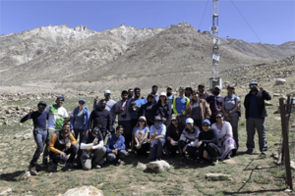
The school featured interactive lectures and tutorials by local and international experts, including Dr. Saurabh Vijay (IIT Roorkee), Dr. Argha Banerjee (IISER Pune), Dr. Pankaj Kumar (IISER Bhopal), Dr. Bedartha Goswami (IISER Pune), Dr. Edward Hanna (U. Lincoln, UK), Dr. Lilian Schuster and Dr. Emily Collier (U. Innsbruck, Austria), covering the important aspects of programming, climate and glacier science, climate change, numerical modelling, and statistical methods. The curriculum was complemented by evening guest lectures on a variety of topics, from basic research to water resource management using ice stupas to mountaineering, and culminated in independent and collaborative work on a glaciology-related project. The school also featured an exciting field trip to Khardung Glacier, located at an elevation of about 5200 m above sea level.
Hands-on experience on VSC-5
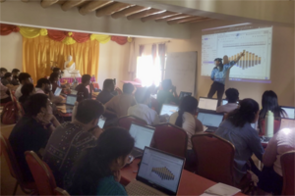
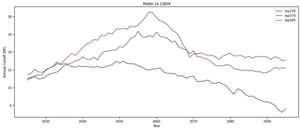
Computational resources and technical support for the tutorials was provided by Austrian Scientific Computing (ASC). Using resources at VSC-5, students got hands-on practice projecting future glacier volume, area and runoff using the global glacier evolution model OGGMCOSIPY
A unique resource for training local glaciologists
The LIGSS compliments existing international glaciological summer schools in Alaska, US and Karthaus, Italy, and aims to train the next generation of local glaciologists to understand how the climate and cryosphere will change in the Himalayas in a warming world. In future years, the summer school will extend the curriculum to include other relevant topics like remote sensing and field measurement techniques.
Check out the YouTube videohere
We are very grateful to Dr. Claudia Blaas-Schenner and Austrian Scientific Computing (ASC) for supporting LIGSS-2025.
Afterword
The organization of the LIGSS was spearheaded by Dr. Saurabh Vijay, Dr. Argha Banerjee and Dr. Pankaj Kumar. Generous support for this initiative was provided by the Sai Asharaya Trust and the International Glaciological Society. The participation of Dr. Emily Collier was supported by the International Relations Office at the University of Innsbruck.
(Announcement first posted on 08.08.2025.)